


Choosing which products to feature is one of the most consequential and most tedious parts of building a campaign, and the standard options are all bad. A marketer picks products by hand, one campaign at a time.
Or a tool matches on keywords. Or the email drops in a generic best-seller block. None of these actually understands what the campaign is about.
How it is done today, and why it is weak
Manual selection is slow and does not scale to per-segment personalization. Keyword search matches strings, not intent, so "summer grilling essentials" misses grill brushes and cast-iron skillets unless those exact words appear in the product copy.
And a best-seller block is the laziest option of all: it ignores the campaign theme entirely and shows the same five products regardless of what the email is about. Even basic "you may also like" recommenders tend to return near-duplicates, five variants of one item, which is a monotony, not a merchandised campaign.
Why we think this is worth getting right
Improving a brand's workflow means removing the judgment-heavy, repetitive steps a marketer dreads, and product selection for every campaign is exactly that. The same email with the wrong products underperforms, so this is not a cosmetic step, it is a revenue lever. Getting it right, and doing it invisibly and instantly, is what lets the rest of the campaign be built end to end without a human stitching in the merchandising by hand.
It starts by enriching the catalogue
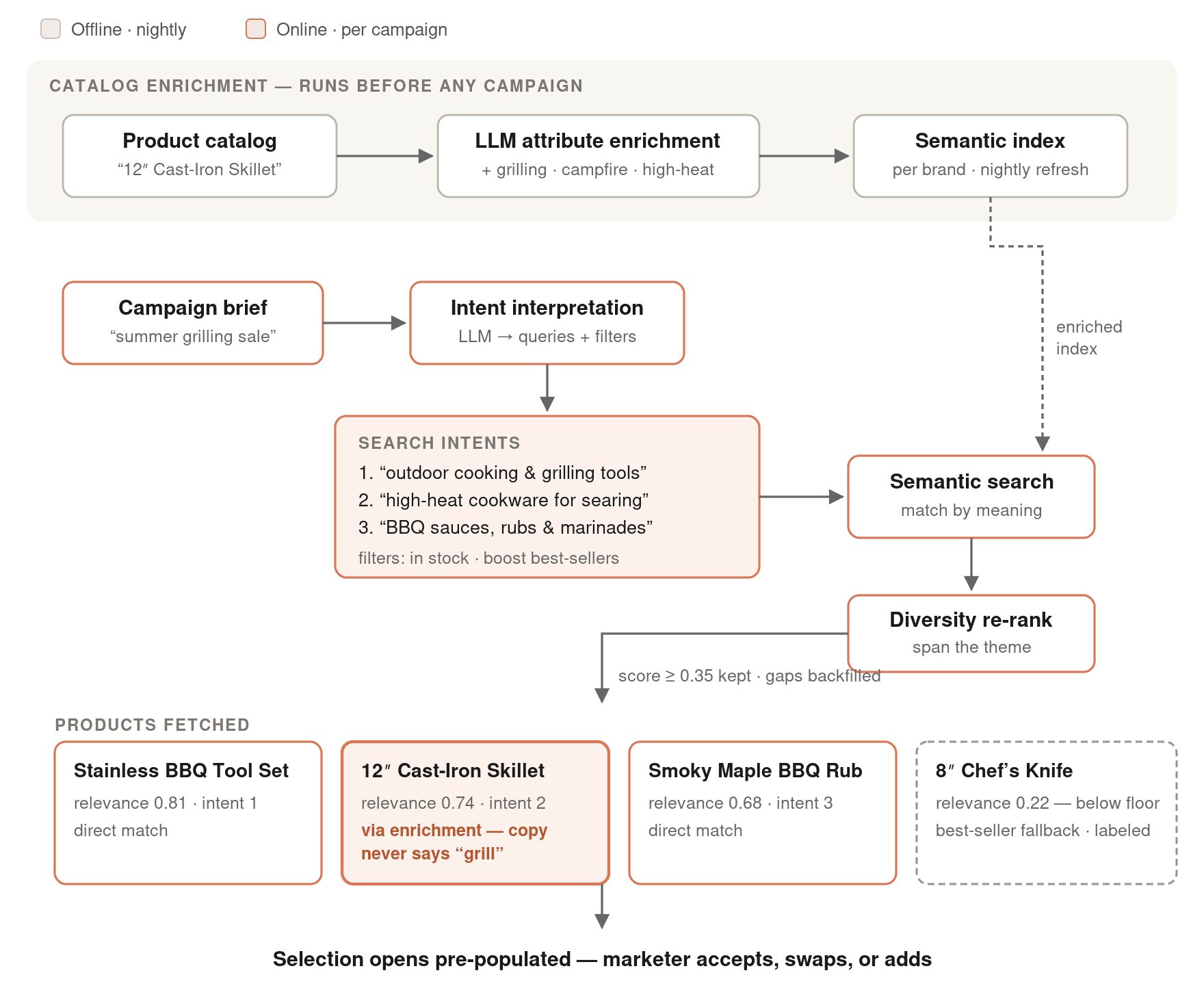
Before any campaign ever asks for products, an enrichment pipeline has already read the whole catalogue. Raw product copy is usually thin: a title like "Everyday Skillet, 10 inch" carries almost no signal. So a set of AI agents reads every product's title and description and extracts the attributes the copy implies but never states: material, use case, occasion, style, and who it is for.
That "10-inch cast-iron skillet" becomes searchable as outdoor cooking, camping, gift-for-cooks, high-heat searing. The enrichment is what closes the vocabulary gap between how marketers describe a campaign and how product copy is actually written, and it is why "summer grilling essentials" can find a skillet whose description never mentions grilling.
How LTV.ai approaches it
When a campaign brief arrives, it is interpreted into one to three targeted search intents plus structured filters that ride along, things like a price band, new arrivals, or best-sellers, so "premium gift picks under 100 dollars" becomes both a meaning-based search and a price constraint.
Each intent is matched by meaning against a per-brand semantic index of the enriched catalogue, the results are re-ranked for diversity so the selection spans the theme rather than clustering on one item, and a confidence threshold decides whether to fall back to best-sellers, which are always labeled as fallback so real matches are never quietly padded with filler.
That honesty about confidence, always labeling a fallback as a fallback, is itself part of keeping the system accountable. And selection is prepared ahead of the moment the marketer reaches it, so the step opens already populated; if preparation has not finished, manual selection still works and nothing blocks.
How it stays honest and compounds
Selection is grounded in the brand's real catalogue and its sales reality, and the catalogue representation is kept current so recommendations reflect what is actually in stock. As segmentation sharpens, the same engine produces per-segment selections, so one campaign idea becomes many targeted variants without a human building each. It is an AI merchandiser, not a keyword search with a nicer label.
Frequently asked questions
Does it just push best-sellers? No. Best-sellers are a labeled fallback; the primary selection is by semantic relevance and diversity.
Can I override it? Always. You accept, swap, or add products.
My product titles are terse or SKU-like. Will this still work? Yes. The enrichment pipeline infers attributes from descriptions and context, so recommendation quality does not depend on well-written titles.
Part of the machine learning behind LTV.ai.
See it on your store: book a demo.