


Watch how a subject line actually gets chosen on most ecommerce teams. Someone writes one line and sends it to everyone.
On a good day, they set up an A/B test: two variants, a straight 50/50 split, wait a few hours, send the winner to the rest. That is the state of the art for the single most consequential line in the email, and it is a remarkably crude tool for the job.
How it is done today, and why it is weak
A 50/50 split has three problems that compound. It needs volume to reach statistical significance, so on any normal-sized list it never actually gets there. It resolves after most of the send is already out, so the "winner" is applied to whatever audience is left rather than the whole list. And it crowns a single global winner, which assumes every recipient responds to the same line, when they plainly do not.
Worst of all, the test is thrown away at the end. Next campaign, the team starts from zero again. There is no memory, no accumulation, no learning that carries forward.
Why we think this is worth getting right
The subject line is the highest-leverage, lowest-information decision in the whole channel: it gates every downstream open, click, and dollar, and teams decide it on a coin flip. If you can turn that one decision from a guess into a learned, per-recipient prediction that improves every campaign, you move the ceiling on the entire program. That is a large return hiding behind a decision everyone treats as trivial.
How LTV.ai approaches it
We reframe the subject line as a decision made continuously during the send, not a bet locked in beforehand. The system generates a pool of candidate variants, and a marketer can add their own variants to the pool, not just the AI-generated ones.
The send then flows out in graduated batches that start small and grow: the first batches are small and exploratory, and each later batch is larger. Because the batches are staggered and increasing, real optimization kicks in by the second batch, not only at the end of the send.
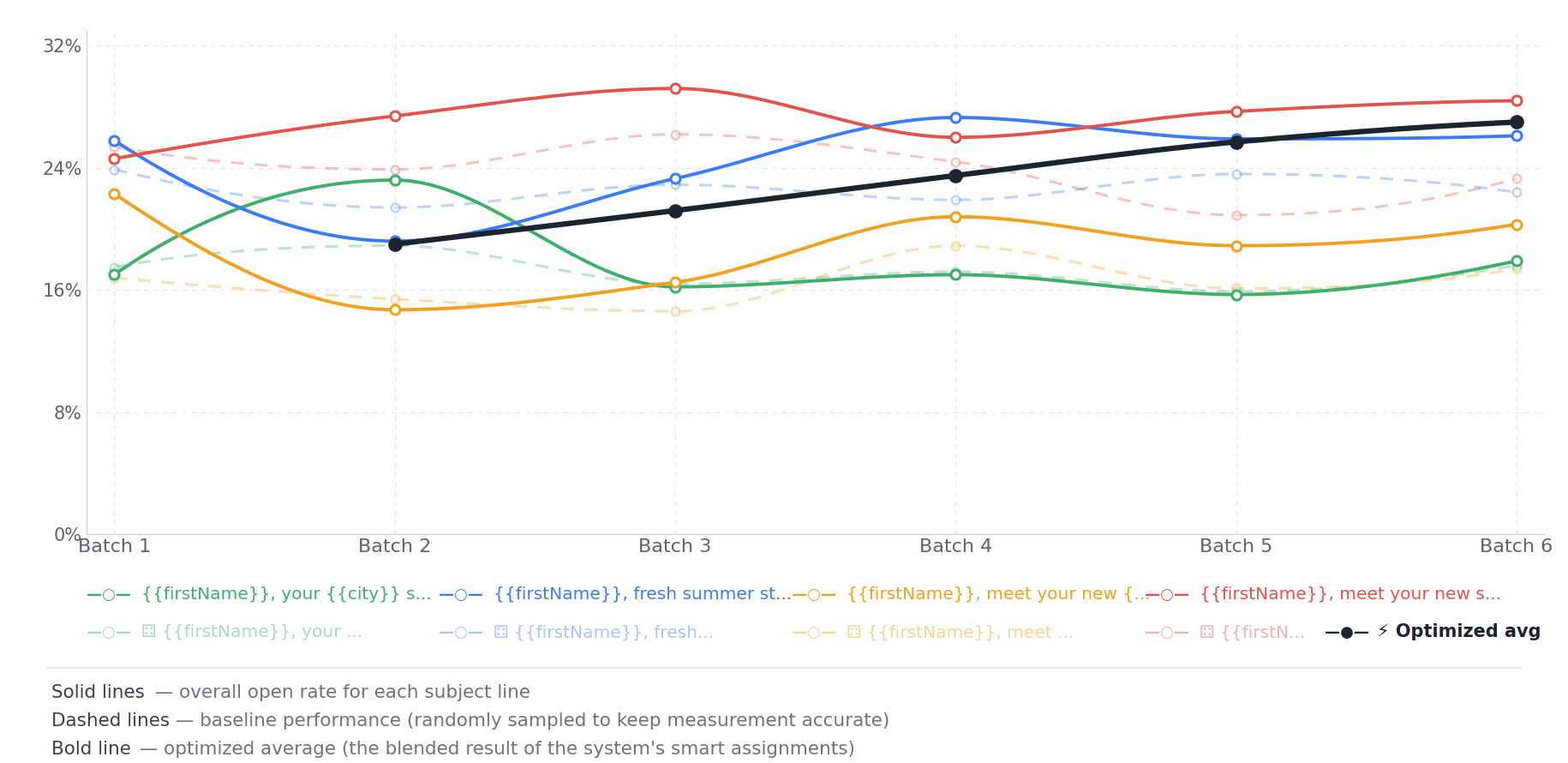
Recipients are not assigned to batches at random. Each recipient is placed in a batch that overlaps their own predicted best send hour, and the small exploratory batches go first. That does two things at once: it keeps the timing right for each person, and it controls for timing as a confound, so the open-rate signal reflects the subject line, not who happened to get mailed at a better hour.
What updates between batches is not a simple scoreboard of average open rate per line. The system retrains a model on recipient-by-variant outcomes, so it learns which kinds of lines work for which kinds of people, then scores the not-yet-sent recipients against that model. The choice is also personal: the model compares each candidate to the kinds of lines a recipient has opened before, style and substance rather than exact words, and sends each person the one they are most likely to open.
The candidate pool itself is seeded from what has worked for this brand, drawn from Brand DNA (see the machine learning behind LTV.ai).
How it stays honest and compounds
Batches that have already sent are frozen, so the system never rewrites its own history to look better, and model quality is tracked per campaign so results are auditable.
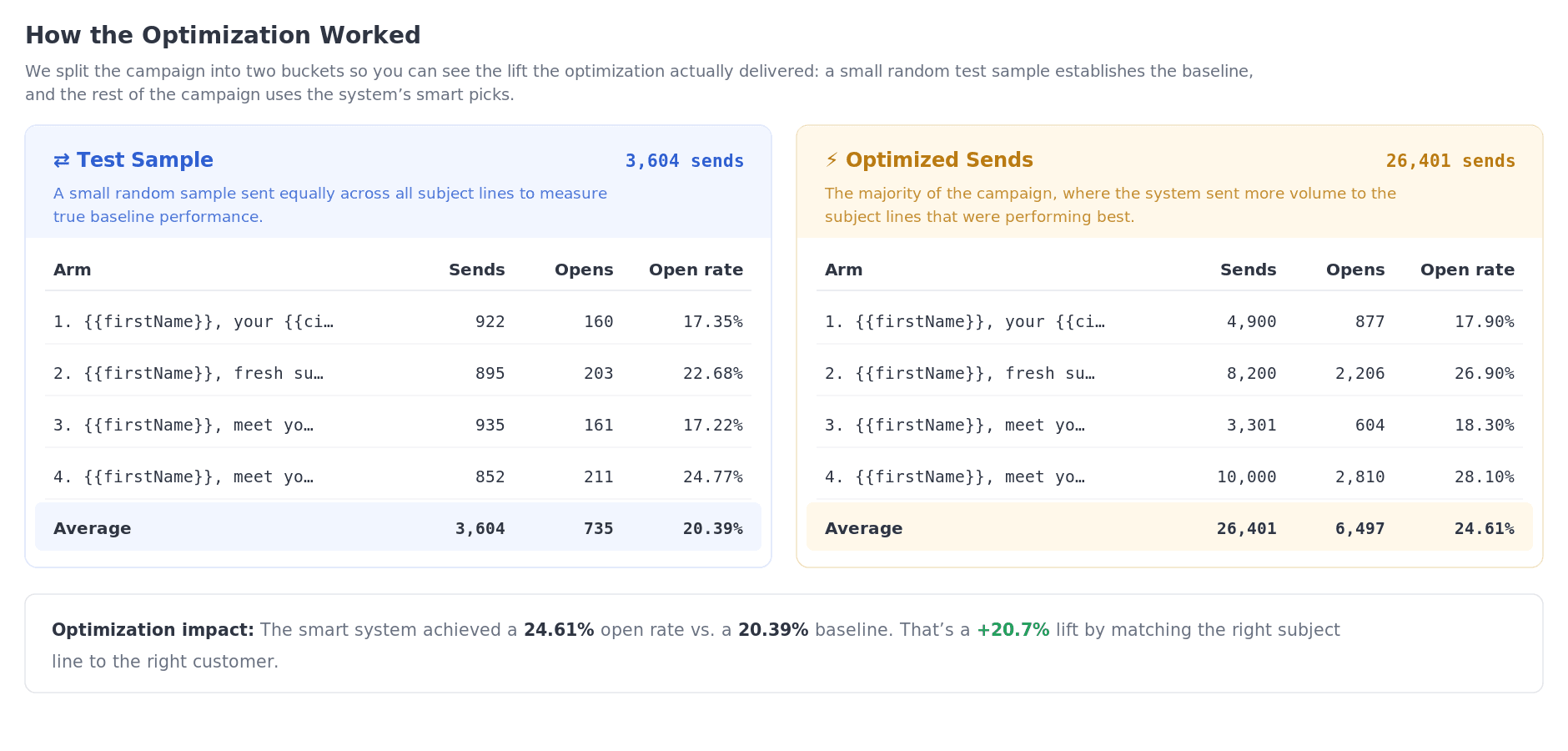
The candidate pool is seeded from what has worked for this brand, drawn from Brand DNA (see the machine learning behind LTV.ai), and every send teaches the system more about which lines land with which recipients, writing back so the next campaign starts sharper than the last. Unlike a 50/50 split, the learning does not reset.
Frequently asked questions
Does this delay the send? No. It works across the batches of a normal send, which are staggered and send-window-aware rather than fired all at once.
Is it one line for everyone? No. It retrains on recipient-by-variant outcomes and personalizes per recipient while still learning the overall winner.
What happens with a brand new brand and no history to learn from? The worst case is a plain even split across variants, which is exactly the status-quo A/B test. It only gets better from there as feedback arrives.
Aren't opens noisy now, with privacy features auto-opening mail? Some opens are inflated by privacy proxies, so the loop is built to optimize a relative signal across variants sent under the same conditions, and subject-line choice is only one input into a system that is ultimately measured on revenue against a holdout, not opens alone.
Part of the machine learning behind LTV.ai.
See it on your store: book a demo.